Article
Get a free 30 Day Stage Portal Trial Get a free 30 Day Stage Portal Trial Access Now

Get exclusive resources, gig management tips, and tools straight to your inbox.
A Stage Portal Band Guide
Most bands start with t-shirts. That makes sense. They're familiar, fans buy them, and there's a well-worn path for getting them made. But if t-shirts are the only thing on your merch table, you're leaving both revenue and opportunity on the floor.
The merch that stays in someone's life, the item that genuinely keeps your band front of mind long after the show, is rarely a t-shirt. It's the bottle opener that ends up on a keyring. The fridge magnet that's looked at a dozen times a day. The lighter that gets pulled out in front of strangers every time someone needs a light. I still have a bottle opener from a band I used to watch regularly. They split up years ago. The bottle opener is still on my keyring.
That's the thing most bands miss about merch. A t-shirt might get worn ten times before it ends up at the back of a drawer. A useful everyday object keeps working for your band long after the show is forgotten.
This guide is about how to choose the right merch for your band, not just a list of ideas, but a practical framework for thinking about what to make, what to sell at the table, and how to know if it's actually worth your money. It's written from the perspective of people who have been at merch tables on both sides: as gigging musicians managing our own stock, and as venue operators watching what fans actually bought and carried home.
The most common merch mistake isn't choosing the wrong items. It's not thinking about merch strategically at all.
Most bands treat merch as a side consideration, something to sort out a couple of weeks before a significant show, ordered in bulk because the minimum order quantity forced it, priced without knowing the actual margin, and sold without tracking what moved and what didn't. Then, several unsold boxes later, the calculation looks worse than it should.
The bands that get merch right treat it as a system, not an afterthought. They think about three things that most bands don't:
1. Daily reach vs. occasional reach. A t-shirt reaches people when it's worn. A fridge magnet, a lighter, or a tote bag reaches people every single day without the fan making a conscious choice to display your band. The best merch earns its place in someone's daily routine.
2. Price point spread. If everything on your merch table costs £20 or more, you're cutting out the casual fan who wants to support you but isn't ready to commit to a full purchase. A £3 sticker or a £5 badge gives them an entry point. That sale matters, both financially and because that sticker goes on a guitar case or a laptop lid and starts working for you.
3. Actual profitability. Merch can feel profitable on a good night. But once you factor in print minimums, unsold stock, transport, and table fees (at larger venues), the margin on many merch items is thinner than it looks. Knowing your actual profit per item per show changes how you plan your table.
Before getting into specific items, it's worth having a framework for how to think about your merch table. We use three tiers:
Tier 1 — Impulse items (under £5) Low cost, high volume potential. These are the items people pick up on a whim, often as an add-on to something else. Stickers, badges, guitar picks, fridge magnets, cable ties. Cheap to produce, easy to carry, and they spread your band's name into everyday environments you'd never reach otherwise.
Tier 2 — Mid-range items (£10–£25) Your workhorse items. T-shirts, tote bags, enamel pins, bottle openers, lighters. These need a good margin and a strong design to justify the price. They're what most fans budget for at a show.
Tier 3 — Premium items (£30+) Limited edition pieces, vinyl, signed items, high-quality hoodies. These won't sell in high volume but they command strong margins and serve your most committed fans. They also anchor the price perception of everything else on the table, if your most expensive item is £50, the £15 t-shirt feels like a bargain.
A well-organised merch table has something in each tier. It gives every fan a way to buy something, regardless of how much they have in their pocket that night.
Here are the items worth considering, with honest notes on what makes each one work or fail at the grassroots level.
Stickers
The gateway item. Cheap to produce, easy to carry in bulk, and the item most likely to end up in a public place where strangers see your band's name. Fans stick them on guitar cases, laptop lids, water bottles, and van bumpers.
Die-cut stickers (cut to the shape of your logo or artwork rather than a rectangle) look significantly more professional and aren't much more expensive at most quantities. Order 500 and the unit cost drops to almost nothing. Sell them for £2–3 or give them away with purchases, either way, they're working.
Worth it for: Every band, at every level. No minimum size or following required.
Enamel Pins
Pins sit in an interesting space: they're small and affordable to produce, but they look premium. Fans wear them on jackets, bags, and guitar straps, which makes them visible in daily life without requiring the fan to build an outfit around them.
They work particularly well as collectibles, limited edition pins tied to specific shows, tours, or album releases give dedicated fans a reason to buy every version. The secondary market for band pins (particularly in metal and punk scenes) is real.
Worth it for: Bands with a strong visual identity or dedicated fanbase. Less effective if your logo or artwork doesn't translate well to a small format.
Bottle Openers and Lighters
Two of the most underused items in grassroots band merch, and two of the most effective at the thing merch is actually trying to do: keep your band in someone's daily life.
A branded lighter costs around £1–2 to produce at reasonable quantities and sells for £5–8. Every time it comes out, your band's name is in front of someone. A bottle opener on a keyring is used constantly, by the fan and by whoever they're drinking with. These aren't glamorous merch items. They're working items, and that's exactly the point.
Worth it for: Any band playing venues where people are drinking (which is most venues). The production cost is low enough that the risk is minimal.
Fridge Magnets
Underrated. A fridge magnet gets looked at multiple times a day in a domestic space, far more than a poster on a wall, which becomes invisible after a week. They're cheap to produce, take up almost no space in a bag or box, and they sit in the impulse tier without requiring much of a decision from the buyer.
Worth it for: Bands with strong, simple artwork that works at small scale. Less effective for typographic-heavy designs that don't reduce well.
Tote Bags
Tote bags have earned their place in the merch ecosystem and it's not hard to see why. They're genuinely useful, they're carried in public regularly (often to places like farmers markets, record shops, and independent cafés, exactly the spaces where your potential audience lives), and they're eco-conscious at a time when that matters to a lot of people.
The risk with totes is quality. A thin, cheap tote bag with an average print looks exactly like a cheap tote bag with an average print. The production cost difference between a thin bag and a decent canvas tote is small. The perception difference is significant.
Worth it for: Most bands. Particularly effective if your audience skews toward the kind of people who carry tote bags (which is a broader demographic than it sounds).
Patches
Patches have had a consistent following in the grassroots music scene for decades, particularly in punk, metal, and indie. They're small, affordable, and they go on denim jackets, bags, and backpacks, often in collections alongside other bands' patches, which puts your band in direct visual conversation with artists your fans also love.
The appeal of patches is partly nostalgic and partly practical: they're one of the few merch items that fans customise and personalise, which gives them a different relationship with the object than with a standard t-shirt.
Worth it for: Bands in scenes where patch culture already exists. Less natural for some genres.
Guitar Picks and Drumsticks
Picks are arguably the most music-specific item you can sell, which makes them interesting. For fans who play guitar, a pick with your band's logo on it is used during practice, your band is present in the most private, creative moments of someone else's musical life. That's a different kind of reach than a t-shirt.
Drumsticks work similarly for the drummer fans in your audience, though the volume of people who drum is obviously smaller.
Custom picks can be produced in large quantities for very little money. Bundling them with other items (a pick plus a sticker for £3, for example) is a clean way to add perceived value to the table.
Worth it for: Bands with an audience of musicians. Less effective if your fanbase is primarily listeners rather than players.
Posters and Prints
Gig posters have a long history in live music and they still work, but with a caveat: the design has to be genuinely good. A forgettable gig poster doesn't go on anyone's wall. A well-designed, limited-run print for a specific show becomes a collectible.
The most effective approach is to commission a proper illustrator or designer for poster runs rather than doing it in-house with a generic template. The cost difference per unit is small when printed at A2 or A3; the difference in whether fans actually want them is significant.
Worth it for: Bands with a distinctive aesthetic or visual identity. Particularly effective when tied to notable shows (sold-out nights, festivals, last-ever performances at a venue).
Tapes and Vinyl
Physical music formats have made a genuine comeback, and not just as a nostalgia play. For the right band and the right audience, selling limited-run tapes or vinyl at your merch table is both a revenue opportunity and a statement about the permanence of your work.
Cassettes, in particular, are worth considering for grassroots bands: the production cost is low compared to vinyl, the aesthetic is strong in certain scenes, and there's a collector culture around independent releases.
Worth it for: Bands with recorded material and an audience that cares about physical formats. Less viable for artists at the very earliest stages.
Functional Everyday Items
The broader category that covers cable ties, carabiners, keyrings, reusable cups, water bottles, things with a practical function that happen to have your brand on them.
The logic for these is the same logic behind lighters and bottle openers: an item that gets used daily keeps your name in front of someone regularly. The specific item you choose matters less than whether it fits into how your audience actually lives. Know your audience. A cable tie is the right call for a band whose fans are mostly musicians or crew. A branded enamel mug might be a better fit for a folk act whose audience leans toward slow mornings and independent cafés.
Worth it for: Bands who know their audience well enough to pick something genuinely relevant to how they live.
The most common merch mistake at the grassroots level is over-ordering. Bands order 200 t-shirts because the price break looked appealing, sell 40, and spend the next two years carrying the remaining 160 to every show.
Start conservatively. Test small quantities of new items. Track what sells and what doesn't. The only way to know your actual best sellers is to pay attention to the numbers over time.
A simple per-show record of what you brought, what you sold, and what you took home is the beginning of a merch strategy. It sounds obvious, but most bands don't do it. When you have that data across three or four shows, you start to see patterns: which items move consistently, which items only move at certain types of shows, which items you're pricing too high or too low.
Tracking your merch income and costs alongside your gig expenses gives you a clear picture of what each show actually made you, not just the fee, but the full picture. That's the information that helps you make smarter decisions about what to invest in next.
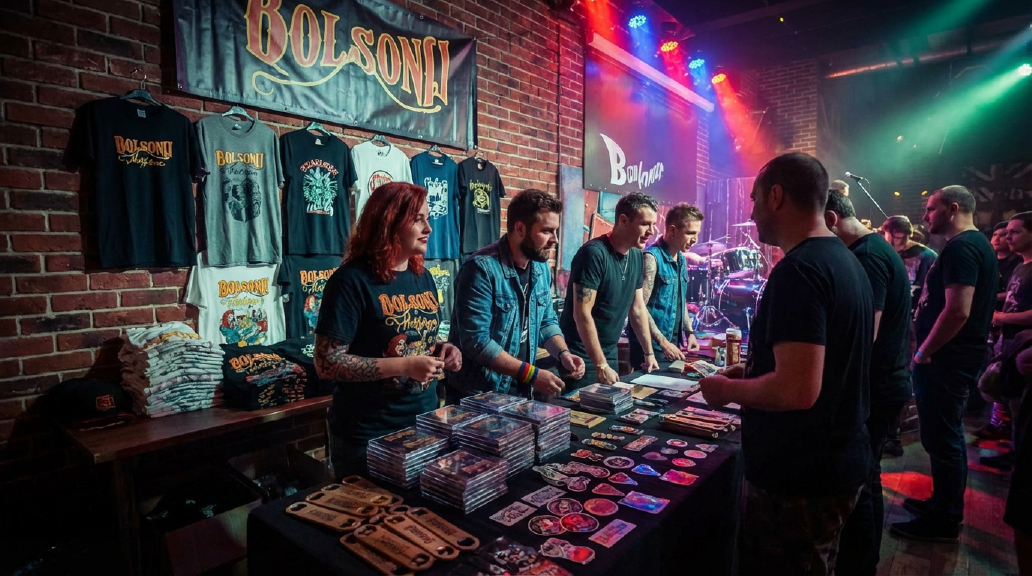
The best merch in the world doesn't sell itself if it's presented badly. A folded stack of t-shirts at the back of the room, in the dark, after the band has left the stage, is not a merch table. It's a pile of clothes.
A few things that make a real difference at the grassroots level:
This is the most important one. Fans buy from people, not from tables. If a band member or someone known to the band is at the merch table after the set, sales go up significantly. It's an opportunity for a genuine connection, and that's what people are paying for.
Especially in small, dark venues. A small battery-powered lamp on or behind the table costs almost nothing and makes everything visible.
Folded t-shirts on a flat table are less visible than t-shirts hung up or displayed in a frame. If you have a way to show the design at eye level, use it.
Not having card payment in 2026 is leaving money on the table. Most fans don't carry cash. Sum Up and similar readers cost almost nothing and pay for themselves at the first show.
People don't like asking how much things cost. If the price isn't visible, some people will walk away rather than ask.
Merch feels profitable on a good night. The reality of the margin, once you account for production costs, transport, and unsold stock, is often thinner than the cash in your hand suggests.
The only way to know what your merch is actually making you is to track it properly: what you paid to produce each item, how many you sold, at what price, at which shows. That information turns a feeling into a number, and numbers help you make better decisions about what to reorder and what to drop.
We've built expense tracking directly into Stage Portal so you can log merch costs and income alongside your other show expenses and see what each gig actually made you — including what the merch table contributed or cost.
Read the guide on tracking expenses in Stage Portal →
Just starting out (first 10 shows): Stickers, badges, one t-shirt design. Keep it simple, keep the investment low, learn what your audience responds to.
Building momentum (regular local shows): Add a tote bag, a lighter or bottle opener, and one higher-margin item (hoodie or limited poster). Consider patches if you're in a scene where they're relevant.
Touring or festival circuit: Full tier structure with impulse items, mid-range staples, and at least one premium item. Card reader essential. Someone at the table after every set. Tracking sales per show.
Whatever you decide to sell, a few principles hold across every level:
Daily use beats occasional use. An item that's part of someone's daily life is worth more to your band than one that stays in a drawer.
Useful beats decorative. The best grassroots merch does something. It opens bottles, holds cables, carries shopping, keeps things warm.
Quality justifies price. A badly made item at a grassroots price point damages your reputation as much as a badly mixed record. If you can't afford to make it well, don't make it yet.
Sell what fits your audience, not what looks good on someone else's table. The right merch for a doom metal band playing 200-capacity venues is different from the right merch for a folk duo doing house shows. Know who you're selling to.
Track the numbers. You can't improve what you don't measure. Know your margins, know your best sellers, and let the data guide what you invest in next.
Each week we send out our newsletter with tips, tricks and guides for bands and event organisers.
Discover the latest insights.
Cookie Settings

We use strictly necessary cookies to keep the site running. With your permission we'd also like to use others to help us to improve your experience by providing insights into how the site is being used
Strictly Necessary
Required for the site to function. Cannot be disabled.
Analytics
Analytical cookies help us to improve our website by collecting and reporting information on its usage.
Marketing
We use marketing cookies to help us improve the relevancy of advertising campaigns you receive.
Read our Privacy Policy for more information.